
Market Pulse October 2026
TSX flat, U.S. stocks pull back as inflation persists
Financial markets provided more tricks than treats in October. While economic growth remains resilient, higher energy prices, trade uncertainty and elevated bond yields have changed the monetary policy outlook. Meanwhile, strong corporate earnings are increasingly being met with greater investor scrutiny around valuations and returns on AI investment.
Canadian equities finished the month just barely in positive territory, as the S&P/TSX returned 0.33% on a price-return basis.
Inflation has continued to be sticky, with headline CPI hovering around 3% since April, driven by higher energy costs. The Bank of Canada (BoC) says it now expects inflation to remain above 3% through much of 2027. Consequently, the BoC raised its policy rate by 25 basis points to 2.50% on October 28, its first increase since 2023, with the move aimed largely at limiting the risk that elevated energy costs could become embedded in broader inflation.
Canadian equities continued to benefit from their distinctive sector composition. Higher energy prices have supported the resource-heavy Canadian market, while the combination of energy, financials and materials gives the TSX considerably less exposure to the AI-related volatility affecting U.S. technology stocks.
The Canadian backdrop isn't without challenges. Higher interest rates, softer employment conditions and Canada-U.S. trade uncertainty could weigh on more domestically sensitive companies. However, Canada's very different sector composition can provide useful diversification alongside U.S. equity exposure.
Underlying U.S. strength, but slower hiring
U.S. equities had a tough month, with both the S&P 500 Index and Nasdaq Composite Index posting negative returns of 0.9% and 5.3%, respectively, in U.S. dollar price-return terms.
The U.S. economy continues to show underlying strength, particularly in consumer spending and AI-related capital investment. At the same time, the labour market is cooling: September unemployment edged up to 4.2%, while headline CPI accelerated to 3.7% year over year.
This leaves the U.S. Federal Reserve (Fed) confronting an uncomfortable combination of slower hiring alongside persistent inflation. After raising rates by 25 basis points in September, the Fed held its target range at 3.75%–4.00% in October, while maintaining an inflation-focused bias.
Third-quarter earnings remain a significant support for U.S. equities. With 60% of S&P 500 companies having reported, 82% have exceeded earnings expectations, 70% have beaten revenue estimates, and third-quarter earnings are running at roughly 30% year-over-year growth. However, the average earnings surprise was only 2.1%, well below the five- and 10-year averages. Companies are still beating expectations, but by less than investors have become accustomed to.
This has been particularly evident around the AI investment cycle. Capital spending on computing infrastructure and data centres continues to increase rapidly, while investors are becoming more focused on whether that spending will ultimately generate sufficient revenue growth, profitability and returns on invested capital.
The broader message is important: Enthusiasm around AI hasn’t disappeared, but the market is increasingly shifting from rewarding spending to demanding returns. Earnings fundamentals remain constructive, but high expectations leave less room for disappointment and could create greater differentiation among companies and sectors.
Canada, U.S. inflation and policy rates
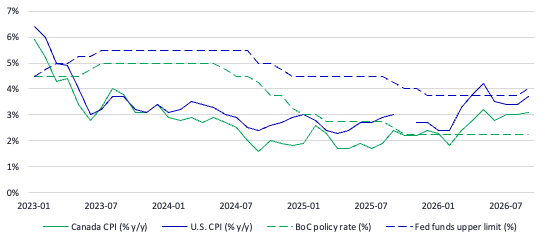
The gap in the U.S. CPI line reflects a missing October 2025 value in the source data due to a U.S. government shutdown.
Source: Bank of Canada; U.S. Federal Reserve, Statistics Canada, Bureau of Labor Statistics, as of September 30,2026.
U.S. yields retreat
After rising sharply in September, U.S. Treasury yields moved lower in October. The 10-year Treasury yield declined from 5.29% at the end of September to 4.98% on October 29, while the 2-year Treasury yield fell from 4.88% to 4.61%. Yields nonetheless remain elevated as investors weigh inflation, monetary-policy uncertainty and government borrowing needs.
Credit markets tell a more nuanced story. U.S. high-yield bond spreads widened modestly, but the deterioration was concentrated among the lowest-quality borrowers rather than signalling broad credit stress in the high-yield market.
This divergence suggests investors are becoming more discriminating about weaker balance sheets rather than broadly abandoning corporate credit, reinforcing the importance of credit quality and security selection.
What to watch
As we head toward 2027, inflation and central-bank policy remain key. Persistent inflation could require further monetary tightening, with implications for bond yields, equity valuations and the broader economy. Investors may want to consider monitoring the following themes:
- The AI conversation is evolving from how much companies are spending to what returns those investments can generate. At the same time, we’re watching whether recent stress in CCC-rated credit remains contained or begins to spread into higher-quality borrowers.
- Canada-U.S. trade uncertainty and the breadth of market leadership remain important themes for 2027. Greater trade-policy clarity would be constructive for Canadian businesses, while broader participation in earnings growth and equity returns would provide a healthier foundation for markets than continued reliance on a relatively narrow group of companies.
U.S. election impact
Investors are already feeling the effects of the U.S. midterm elections, which saw the Democrats take control of both the House of Representatives and the Senate. While financial markets have seen some big swings in the days since the election, the prospect of divided control of the U.S. government raises questions on key issues including tensions in Iran, AI spending, and the Canada-U.S. trade situation.
Bottom line: For portfolios, October's message may ultimately be about selectivity. Economic and earnings growth remain supportive, but inflation, higher interest rates and elevated valuations have raised the bar for markets. We believe this argues for portfolio balance rather than abandoning risk. Equities continue to benefit from earnings growth, but recent market reactions reinforce the importance of valuations, quality and geographic diversification. In fixed income, higher starting yields provide attractive income opportunities, while growing differentiation within credit markets favours an emphasis on quality.
Monthly lookahead
November 6 | Canada U.S. October employment, U. of Michigan consumer sentiment |
November 10 | U.S. October CPI, Bank of Canada summary of deliberations |
November 12 | Canada September building permits, U.S. October existing home sales |
November 13 | Canada September wholesale trade |
November 16 | Canada October CPI |
November 17 | U.S. October retail sales, Canada October housing starts |
November 18 | U.S. October housing starts and building permits, pending home sales, FOMC minutes |
November 19 | U.S. November Philadelphia Fed index |
November 20 | Canada September retail sales |
November 30 | Canada Q3, September GDP |
Important disclosure
The S&P 500 Index tracks the performance of 500 of the largest publicly traded companies in the United States.
The S&P/TSX Composite Index is the benchmark Canadian index that tracks the performance of companies listed on the Toronto Stock Exchange (TSX).
It is not possible to invest directly in an index. Past performance does not guarantee future results.
Investing involves risks, including the potential loss of principal. Financial markets are volatile and can fluctuate significantly in response to company, industry, political, regulatory, market, or economic developments. The information provided does not take into account the suitability, investment objectives, financial situation, or particular needs of any specific person.
All overviews and commentary are intended to be general in nature and for current interest. While helpful, these overviews are no substitute for professional tax, investment or legal advice. Clients and prospects should seek professional advice for their particular situation. Neither Manulife Wealth Inc. nor any of its affiliates or representatives (collectively Manulife Investments) is providing tax, investment or legal advice.
This material is intended for the exclusive use of recipients in jurisdictions who are allowed to receive the material under their applicable law. The opinions expressed are those of the author(s) and are subject to change without notice. Our investment teams may hold different views and make different investment decisions. These opinions may not necessarily reflect the views of Manulife Wealth Inc. The information and/or analysis contained in this material has been compiled or arrived at from sources believed to be reliable, but Manulife Wealth Inc. does not make any representation as to their accuracy, correctness, usefulness, or completeness and does not accept liability for any loss arising from the use of the information and/or analysis contained. The information in this material may contain projections or other forward-looking statements regarding future events, targets, management discipline, or other expectations, and is only current as of the date indicated. The information in this document, including statements concerning financial market trends, are based on current market conditions, which will fluctuate and may be superseded by subsequent market events or for other reasons. Manulife Investment Management disclaims any responsibility to update such information.
Manulife Wealth Inc. shall not assume any liability or responsibility for any direct or indirect loss or damage, or any other consequence of any person acting or not acting in reliance on the information contained here. This material was prepared solely for informational purposes, does not constitute a recommendation, professional advice, an offer or an invitation by or on behalf of Manulife Wealth Inc. to any person to buy or sell any security or adopt any investment approach, and is no indication of trading intent in any fund or account managed by Manulife Wealth Inc. No investment strategy or risk management technique can guarantee returns or eliminate risk in any market environment. Diversification or asset allocation does not guarantee a profit or protect against the risk of loss in any market. Unless otherwise specified, all data is sourced from Manulife Wealth Inc. Past performance does not guarantee future results.
Manulife, Manulife & Stylized M Design, Stylized M Design, Manulife Wealth and Where will better take you are trademarks of The Manufacturers Life Insurance Company and are used by it, and by its affiliates, under license.
6096880